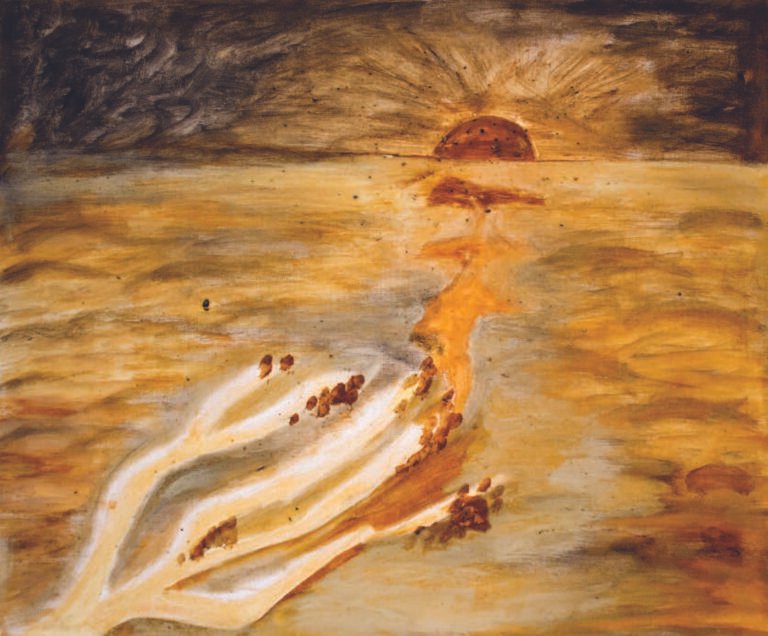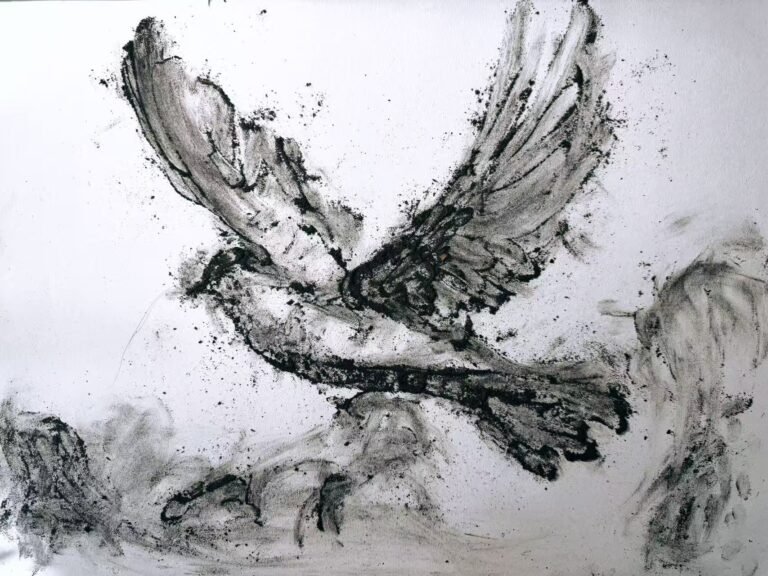
Growing up in Jiangxi, coal was part of daily survival—fuel for cooking and warmth, a witness to the endurance and decline of my hometown. Later, I turned cigar smoking into a ritual of teenage desire and resistance, inspired by my idealistic reading of Che Guevara.
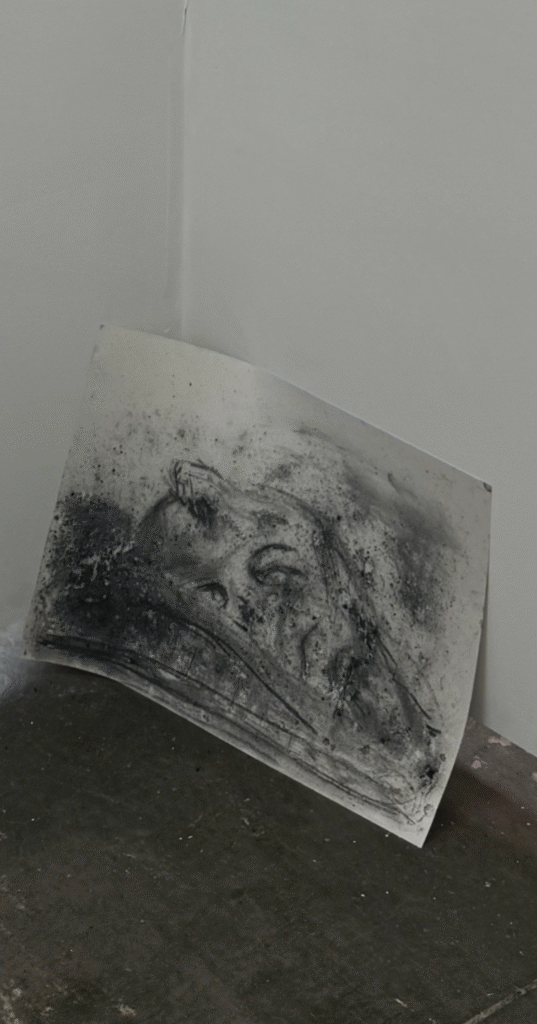
This work is not simply a drawing but a spatial event. The coal-dust portrait of a shattered head — inspired by Percy Bysshe Shelley’s Ozymandias — is deliberately placed low to the ground, tucked into a neglected corner of the exhibition space. Its position is crucial: it resists the “white cube” convention of central, monumental display and instead invites an almost accidental, intimate encounter.
Inspired by the continuation of Shelley’s poem — “…Near them, on the sand, / Half sunk, a shattered visage lies…” — the work humbles itself before time. Its vulnerability is the point: it is not preserved behind glass like a museum artifact but left precarious, exposed to dust and erasure.
Medium-wise, it is a hybrid work: drawing as object, site-specific installation, and performance documentation (the act of placing it in the corner is part of the piece). The photograph you see here is not merely a record but an integral layer of the work, emphasizing its ephemerality.
Thematically, this piece meditates on ruin and entropy. Shelley’s famous line, “Look on my works, ye mighty, and despair,” becomes ironic — not a celebration of power but a quiet acknowledgment that even the mightiest rulers leave behind fragments destined to fade. By allowing the work to sit on the ground, vulnerable and unprotected, I stage a subtle confrontation with the art world’s impulse to monumentalize and preserve.
This work is simultaneously drawing, installation, and performance: it is about making fragility visible and turning the exhibition corner into a site of tension, loss, and critical reflection.
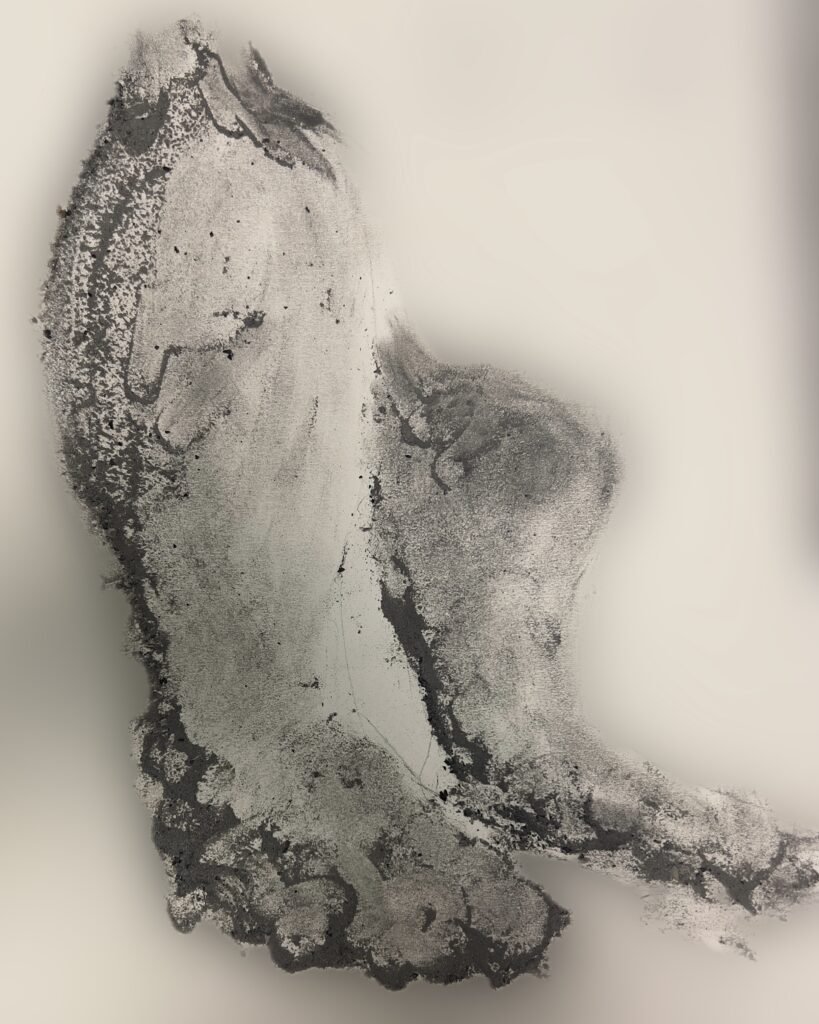
In this work, I use cigar ash as both material and metaphor, letting its fragility mark the paper like two ghostly legs. The title, Look on My Works, quotes Shelley’s Ozymandias—a reminder that all power and monuments turn to dust. This drawing is both a memorial and a question: how do we hold memory when everything drifts away?
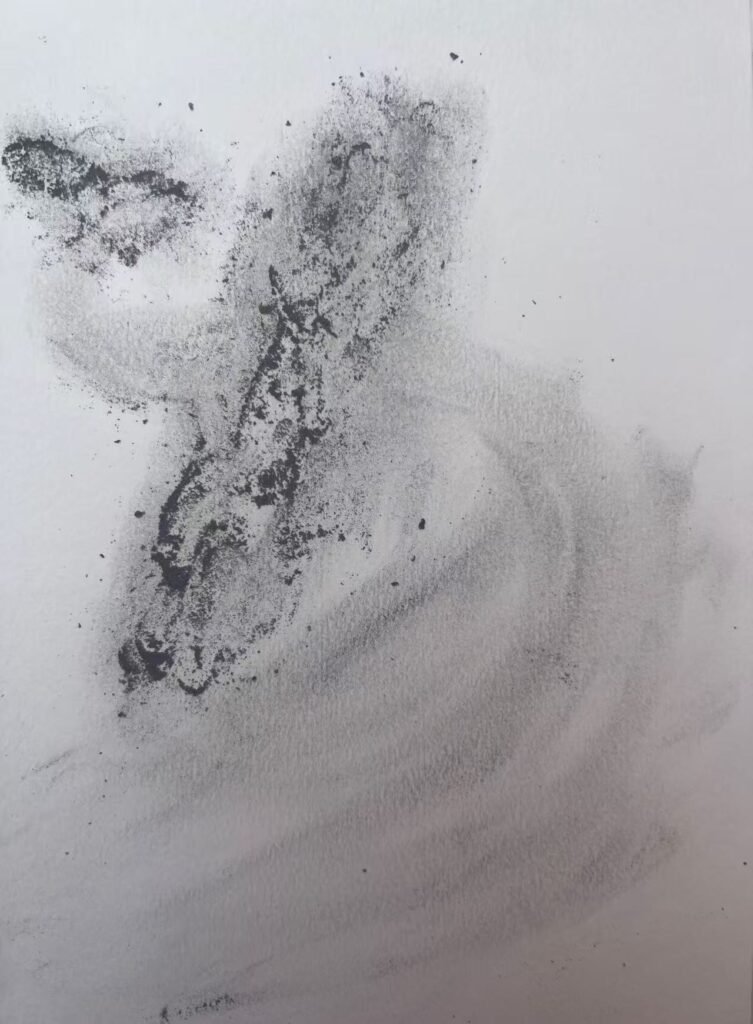
This work transforms an intimate, almost rebellious act — smoking a cigar — into a mark-making ritual. The ashes are my drawing material, leaving traces that are at once faint and dramatic. The dragon motif coils around a central mass like a mountain, evoking both Taoist cosmology and adolescent defiance.
The piece is best understood as performance residue: the act of smoking, tapping the ash, and dragging it across the page is inseparable from the final image. Photography plays a key role, capturing the drawing at its most alive moment before the ash disperses or smudges.
In this work, gesture is foregrounded: the dragon exists only as long as the ash holds its shape. The fragility of the medium mirrors the impossibility of holding on to youth, freedom, or resistance — all are consumed in the same gesture that creates them.
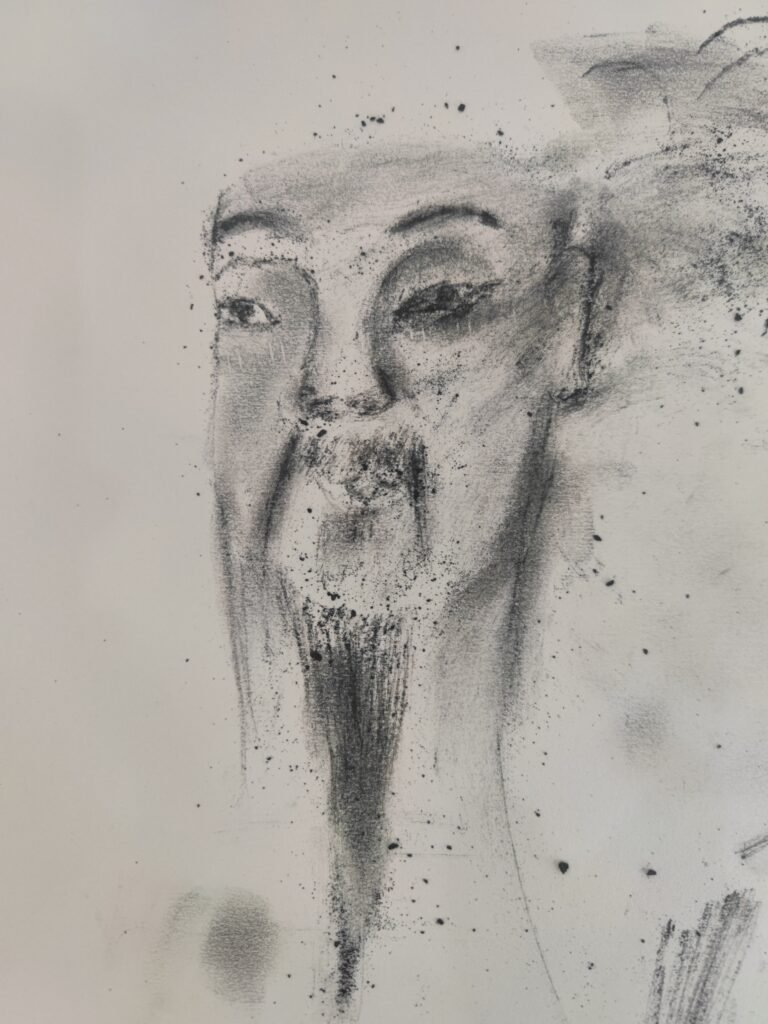
This work merges portraiture, material research, and identity inquiry. Using coal dust from my hometown in Jiangxi — a region historically rich in both coal and classical Chinese culture — I draw the face of Tang Xianzu, the playwright often called the “Shakespeare of the East.” Here, medium and subject are inseparable: coal is not merely a pigment but a carrier of geological and cultural memory. The choice of Tang Xianzu is also biographical: he and I share the same province, and his plays (The Peony Pavilion, The Purple Hairpin) were my earliest encounters with poetic tragedy. Rather than functioning as a commemorative portrait, the work is part of a performative process — the dust is scattered, fixed, and allowed to leave residue on the paper edges, acknowledging its material instability. Displaying it unframed, with particles loose and vulnerable to air, makes the piece hover between drawing and time-based work. This is simultaneously a homage and an experiment: an attempt to write myself into a longer literary and geological lineage, letting the medium carry both the weight of history and the ephemerality of a breath.
See more works in my Coal & Ash series.