The first version of Stacked Cities began with a simple observation: an industrial object is not only standardised so that it looks the same. Its colour, curve, seams and proportions are also designed so that it can be packed tightly, stacked efficiently and transported farther.

A skyline already inside the package
Pringles makes this system unusually visible. The cylindrical cans rise like ready-made towers, while the crisps repeat the same engineered curve. Each element already belongs to an architecture of production and logistics before it enters the studio. I did not need to disguise that architecture. I only needed to exaggerate it.
I began stacking red and green Pringles cans into a small, unstable city. Beside them, I balanced the crisps vertically and used more crisps to form the words: Isn’t it beautiful?
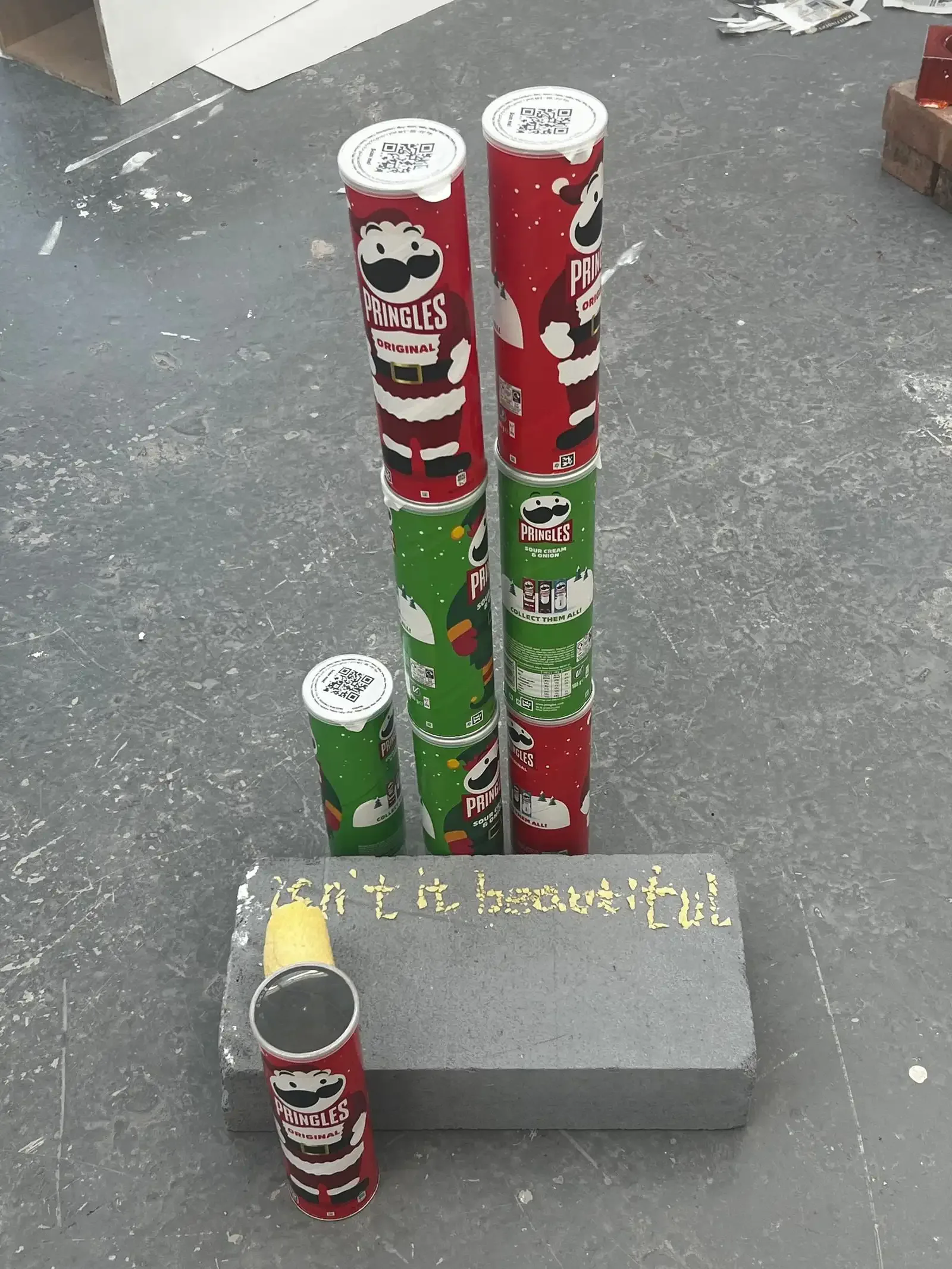
The question is sincere and sarcastic at the same time. Standardisation can flatten difference, but it also makes an object legible across enormous distances. People with very different incomes, languages and cultural backgrounds can recognise the same package, eat the same curve and understand the same joke. In that limited but real sense, a mass-produced snack can cross a class boundary.
I am interested in this contradiction. The project is critical of industrial sameness, but it is not simply anti-consumer. I also recognise a strange intimacy in common products: the knowledge that people in different flats are stacking the same frozen food into their fridges, drinking the same bottled water and eating the same crisps.
That intimacy can be almost embarrassingly small. Two strangers may live a few doors apart in the same apartment plan, open the same crisps, wash with the same soap and decide that the empty can is too useful to throw away. They do not know one another, but their hands repeat the same sequence. If I accept that feeling sincerely, repetition stops being only evidence of conformity. It becomes evidence that we are together.
Repetition as material and language
Repetition is one of the central methods in my practice. I repeat forms, clauses and words until they begin to accumulate weight. A sentence said once is an observation. A sentence repeated three or four times starts to sound like persuasion, advertising, ritual or belief.

The phrase Isn’t it beautiful? behaves in the same way. It is never paraphrased and never replaced by a second question. It simply returns: Isn’t it beautiful? Isn’t it beautiful? Isn’t it beautiful? The installation uses this exact verbal rhythm alongside the repeated cylinder of the cans and the repeated curve of the crisps. Language and material perform the same action: they stack, break into crumbs and stack again.
Warhol’s serial consumer images make the ordinary product visible through repetition. Stacked Cities borrows that recognisable serial logic but gives it a different emotional temperature: less cool, more tender and needy. The product and the sentence repeat until standardisation begins to feel like shared presence.
This is also why humour matters. I prefer an artwork that can be teasing, excessive and emotionally serious at once. The Pringles tower is recognisably absurd. Its absurdity keeps the work open and accessible; it allows a critique of standardisation to arrive through appetite, colour and play rather than through distance or authority.
From object study to modular city
The photographs record connected stages rather than a single final view: the wider studio, the first arrangement of cans, closer views of branded towers and repeated seams, the precarious vertical crisp stack, and edible text spelling Isn’t It Beautiful?

Together, these images show the work moving between sculpture, text, installation and documentation. The project is not only the tower. It is also the act of testing balance, the decision to let packaging remain recognisable, the temporary typography made from food, and the photographs that preserve an arrangement that could collapse or be eaten.

The crisp stack is especially important. Removed from the can, each unit appears almost comically uniform. Yet the taller the stack becomes, the more fragile it looks. Efficiency produces instability. Sameness produces a structure that can fall.
A hopeful poetics of the modular city
In my longer UAL research essay, Polyphony of Ashes and Words: Whispers of Existence, I placed the Pringles experiments beside LEGO city studies, coal and ash drawings, and sculptures of collective animal life. These materials appear very different, but they share a question: how can an individual remain distinct while living inside a larger system?
The modular city can feel cold, repetitive and lonely. It can also be recombined. A module is constrained by its standard dimensions, yet its relationships are not predetermined. It can join another unit, separate, rise, lean or fail.
That possibility gives the project its hopeful edge. Stacked Cities does not offer a romantic escape from standardised life. Instead, it asks whether warmth can be rebuilt from the materials already surrounding us. If the same products and routines shape people in distant rooms, perhaps those repetitions can become evidence of relation rather than only conformity.
From physical process to digital interaction
The modular city is not a digital illustration of a future sculpture. It is a primary form of the artwork. On the website, a procedural city generates itself from cylindrical towers, matching apartment windows, crisp bridges, repeated language and falling crumbs. Each agreement adds another floor. Parallel routines light two windows and create a temporary connection. When repetition becomes excessive, the skyline leans, breaks and begins again.
The first digital study runs as a twenty-four-second loop and can be exported directly as a silent moving-image work. Its city is constructed from a small library of rules rather than a fixed architectural model, allowing later versions to grow through real-time visitors, multi-screen projection or a funded physical installation.
The physical photographs remain available at full resolution. The interactive layer leads back to the work; it does not replace it.
Read the original UAL research essay, Polyphony of Ashes and Words: Whispers of Existence.