“Handmade” is one of the most efficient laundering devices in contemporary culture. It turns labor into atmosphere, exhaustion into charm, and unequal production into an image of care.
The word appears everywhere now: museum shops, biennial wall texts, luxury campaigns, lifestyle boutiques, design fairs, artist editions, Instagram storefronts, and e-commerce filters. It arrives softened by natural light and textured surfaces. It asks to be touched, trusted, and morally approved. Handmade sounds intimate. Handmade sounds ethical. Handmade sounds like the opposite of exploitation.
That is precisely why the word should make us suspicious.
In the contemporary art and design economy, “handmade” often allows institutions and lifestyle markets to celebrate labor aesthetically while refusing to account for it materially. The hand is shown, but the conditions of the hand are not. The gesture is romanticized, but the body is abstracted. The object is praised for its irregularity, but the maker is still expected to deliver consistency, speed, packaging, documentation, platform fluency, and customer service.
Labor becomes visible as texture and invisible as cost.
This contradiction is not new, but it has become newly marketable. In 2025, Vogue Business described craft as luxury’s “most valuable currency,” noting how brands are turning to artisanship, human connection, and behind-the-scenes making as an antidote to consumer fatigue with overexposure and declining trust in quality. The article also warned of “craftwashing,” the use of craftsmanship as superficial marketing rather than material commitment.
That word — craftwashing — matters. It names what happens when the appearance of labor becomes more valuable than the labor itself.
The luxury industry has learned that the hand can repair a damaged aura. After years of algorithmic sameness, inflated prices, and increasingly visible gaps between brand mythology and product reality, craft offers a persuasive solution. It says: there is still skill here. There is still time here. There is still someone behind the object. The artisan returns not as a worker with bargaining power, but as an image of moral reassurance.
The problem is not that luxury brands use craft. Many luxury houses depend on extraordinary material knowledge, training, and technique. The problem is that contemporary culture increasingly treats craft as a visual resource before it treats it as labor. It loves the close-up of hands. It loves the workshop video. It loves the language of patience, tradition, heritage, and touch. It is less interested in wages, ownership, authorship, production timelines, health risks, transmission systems, or who profits when the story of the hand becomes brand equity.
The hand is invited into the campaign. The worker rarely enters the balance sheet.
This pattern extends beyond luxury. Museums and cultural institutions also rely on the ethical glow of craft. Traditional craftsmanship is one of UNESCO’s categories of intangible cultural heritage; UNESCO emphasizes that what matters is not only the finished object but the knowledge, skills, and transmission behind it. Yet in the museum shop or exhibition catalogue, that living system is often compressed into an object label: woven, carved, dyed, embroidered, hand-thrown, hand-finished, heritage-inspired.
The object arrives as evidence of culture. The labor system disappears behind the word.
Recent heritage debates make the stakes clearer. Handloom weavers of Bangladesh’s Tangail saree sought UNESCO recognition for a centuries-old weaving tradition that supports hundreds of families, while facing rising raw material costs, competition from cheaper machine-made textiles, and declining interest among younger generations. Recognition may bring visibility, pride, tourism, and preservation support. But it also reveals a basic contradiction: heritage status can elevate the symbolic value of a craft without necessarily solving the material precarity of the people who practice it.
A tradition can become internationally celebrated while its practitioners remain economically vulnerable.
Japan’s traditional sake brewing was added to UNESCO’s intangible cultural heritage list in 2024, a recognition expected to boost international attention and renew domestic interest as younger generations drift away from the drink. Here too, the language of heritage carries a double burden. It preserves knowledge by making it visible, but it also risks turning living labor into national branding. The craft is honored as culture, marketed as identity, and circulated as soft power. The question is whether the people maintaining the practice gain durable support, or whether they become custodians of an image from which others profit.
This is the central trap of handmade culture: visibility is mistaken for justice.
A craft can be recognized, exhibited, photographed, branded, and sold without the maker gaining security. A technique can be praised as ancient while the people practicing it struggle with contemporary costs. A community can be celebrated as a bearer of tradition while being denied the tools to modernize on its own terms.
The market often wants craft to be timeless. Makers have to survive in time.
This tension becomes especially sharp when craft is tied to non-Western, Indigenous, rural, immigrant, working-class, or feminized labor. These makers are often expected to embody authenticity in a narrow form: rooted, humble, patient, local, spiritual, grateful. Their work is valued when it appears close to tradition and far from strategy. The moment the maker becomes technologically fluent, commercially ambitious, conceptually experimental, or visibly managerial, the fantasy begins to crack.
The “authentic artisan” is supposed to have hands, not a platform strategy.
This is why contemporary craft discourse often punishes modernity. A maker who sells through Instagram may be seen as less pure. A textile artist who uses digital tools may be seen as less traditional. A craftsperson who builds a brand may be seen as too commercial. A rural cooperative that adopts e-commerce may be praised for empowerment only if its digital presence still performs local innocence.
Western markets, in particular, often like authentic craft until craft reveals that it knows how markets work.
The artisan is permitted to be skilled, but not too strategic. She may carry history, but not ambition. She may represent cultural memory, but not demand full authorship. She may be visible as a hand, but not as an entrepreneur, technician, platform operator, intellectual, or future-facing designer.
This is not respect. It is containment.
The containment is gendered. Craft has long been associated with domestic labor, decoration, textiles, ceramics, bodily repetition, and the supposedly minor arts. When these practices enter contemporary art, they are often celebrated as forms of repair, care, memory, and resistance — and they can be all of those things. But celebration can also become another form of enclosure if it keeps returning craft to softness.
Textile, clay, beadwork, embroidery, weaving, nail art, adornment, basketry, quilting, and other hand-intensive practices are repeatedly asked to perform intimacy. They are welcomed when they heal, remember, ornament, preserve, or beautify. They are treated with more anxiety when they assert aggression, critique, futurity, opacity, or scale.
The handmade object is allowed to be moving. It is less often allowed to be threatening.
This matters because craft is not naturally gentle. Craft can be technical, brutal, repetitive, toxic, industrial, collective, political, and physically punishing. Hands cramp. Backs bend. Eyes strain. Skin reacts to chemicals. Materials rise in cost. Orders arrive late. Platforms change their algorithms. Buyers ask for discounts. Institutions request “community engagement.” Galleries want documentation. Museums want provenance. Customers want authenticity and tracking numbers.
The romance of the hand rarely includes the hand at the end of the workday.
In this sense, “handmade” functions like “community,” “sustainability,” and “visibility”: a beautiful word that can conceal the transfer of responsibility downward. Institutions and brands use it to signal ethics without necessarily building ethical structures. The word reassures audiences that someone cared. It does not tell us whether that someone was paid, credited, protected, or allowed to define the terms of care.
The handmade object becomes a theater of labor, staged for consumption.
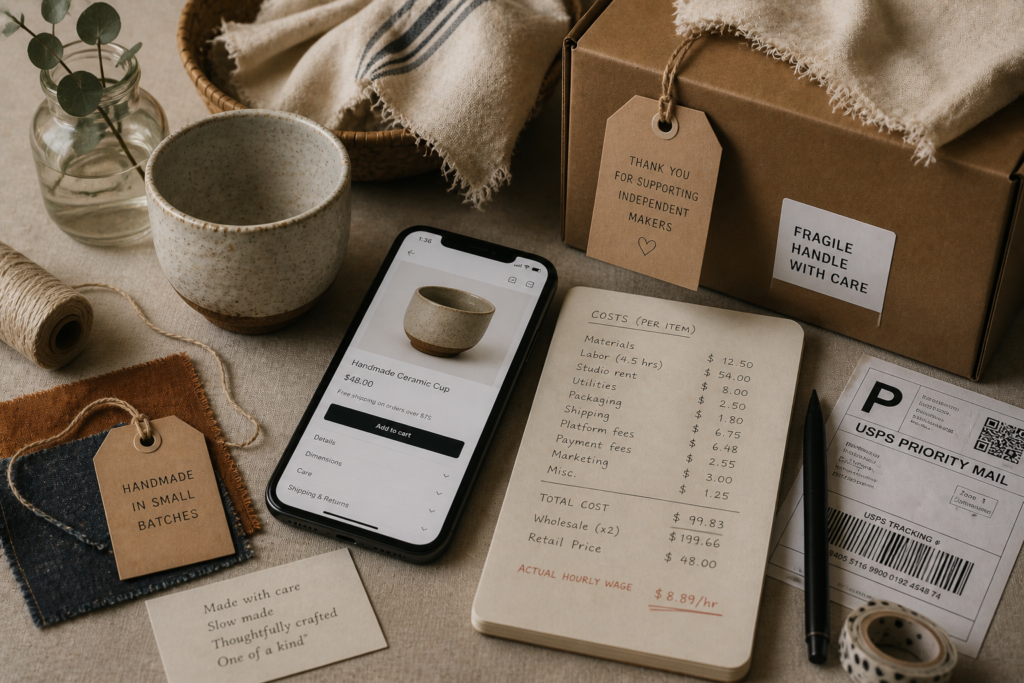
This theater has a recognizable visual script. Natural fibers. Earth tones. Workshop dust. Quiet hands. Slight imperfection. A neutral background. A story about tradition. A sentence about slow process. Maybe a photograph of the maker, but rarely too much information about ownership, pricing, subcontracting, or supply chains. The viewer is invited to feel close to labor, but not to examine it too closely.
The goal is not transparency. The goal is atmosphere.
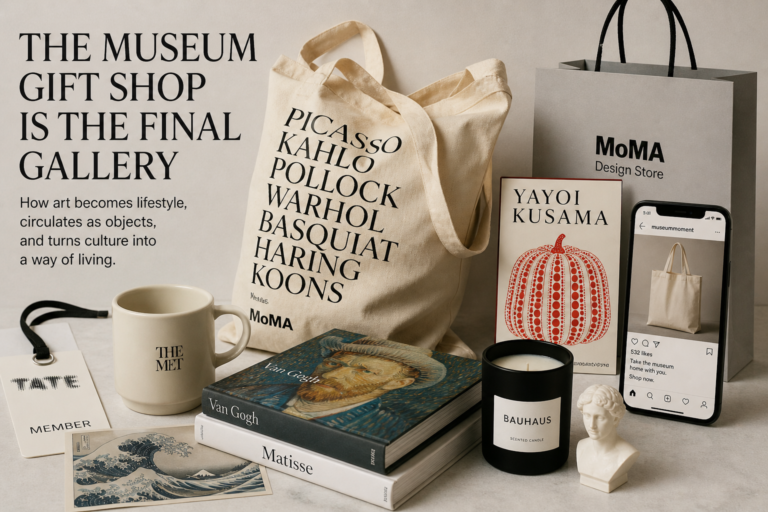
Museum shops intensify this atmosphere. They are full of objects that convert cultural authority into purchasable intimacy: hand-thrown cups, woven bags, artist-designed scarves, small-batch jewelry, notebooks with textile patterns, ceramics that look like memory, candles that smell like an exhibition’s mood. These objects may be beautiful, serious, and ethically made. But the shop rarely asks the visitor to think about the difference between handmade, hand-finished, handmade-looking, artisan-made, artist-designed, heritage-inspired, or outsourced.
Everything becomes “crafted.”
The word is convenient because it is imprecise. It carries the dignity of labor without requiring a labor analysis. It gives the buyer a feeling of participation in a more ethical economy without necessarily disrupting the speed, convenience, or price expectations learned from the least ethical one.
A person can reject mass production aesthetically while still expecting Amazon-like fulfillment.
That contradiction now defines much of the handmade economy. Buyers want the object to feel slow, but they want the shipping to be fast. They want visible irregularity, but not the kind that affects fit, finish, or expectation. They want a human process, but they want frictionless service. They want to support makers, but they often compare prices against machine-made alternatives. They want authenticity, but they also want return policies, discount codes, seasonal drops, and polished packaging.
The maker is asked to be both anti-industrial and perfectly operational.
Digital platforms deepen this contradiction. Online marketplaces turn handmade into a searchable category. Social media turns process into content. E-commerce turns intimacy into conversion. The maker must be visible enough to establish trust, personal enough to appear authentic, and professional enough to reassure the buyer. She must narrate labor without sounding resentful. She must show process without revealing too much fatigue. She must be human, but not inconveniently so.
The platform does not eliminate the workshop. It expands it into every hour of the day.
This is why the contemporary handmade object no longer belongs only to the studio. It belongs to a larger infrastructure: photography, captions, inventory, packaging, taxes, customs forms, SEO, platform fees, email replies, customer education, damage claims, shipping delays, product descriptions, and post-purchase care. The hand is still there, but it is surrounded by administrative labor that rarely fits the romance of craft.
To call an object handmade without naming that infrastructure is to tell only half the truth.
The art world should know better. It has spent decades expanding the definition of artistic labor: performance, maintenance, social practice, research, pedagogy, community work, archival work, care work, administrative labor. Yet when it comes to craft, it still frequently returns to the old hierarchy: the hand as evidence of authenticity, the object as evidence of culture, the maker as evidence of continuity.
That continuity is often demanded from people who are given the least freedom to change.
This is the cruelty of heritage when it becomes a market demand. A practice must remain recognizable enough to satisfy buyers, curators, tourists, collectors, and cultural agencies. It must preserve the past, but also compete in the present. It must resist disappearance, but not transform so much that it loses the aura others came to purchase.
The maker is told to keep tradition alive, but not always allowed to decide what alive means.
A more honest politics of handmade would begin by refusing to treat labor as mood. It would ask who made the object, under what conditions, with what materials, for what compensation, under whose name, with what degree of control over pricing, narrative, and distribution. It would distinguish between collaboration and inspiration, between cultural continuity and aesthetic extraction, between hand labor and hand-themed branding.
It would also stop treating technology as the enemy of authenticity. A craftsperson who uses digital tools is not less real. A weaver with an online store is not less traditional. A ceramicist who understands analytics is not less intimate with clay. A heritage practice that adapts does not automatically betray its origins. Sometimes adaptation is the only reason a practice survives.
The fantasy of pure craft often serves the buyer more than the maker.
Handmade should not mean trapped in the past. It should not mean small, grateful, feminine, local, silent, or poor. It should not mean that the maker’s labor becomes charming only when it appears unstrategic. Craft can be ambitious. Craft can be expensive. Craft can be conceptual. Craft can be industrially aware, digitally fluent, politically sharp, and commercially intelligent.
The hand is not proof of innocence. It is proof of work.
If institutions and markets want to celebrate handmade objects, they should be willing to account for handmade conditions. That means fees that reflect time, not just charm. Labels that name makers, not just techniques. Contracts that protect authorship. Retail systems that explain price instead of hiding behind aura. Exhibitions that treat craft as thought, not merely touch. Heritage programs that support transmission materially, not only symbolically.
It also means allowing makers to be modern without withdrawing the word authentic.
The future of craft will not be protected by nostalgia alone. It will depend on whether institutions, markets, and audiences can stop consuming labor as an image of virtue and start supporting it as a material fact.
Until then, handmade will continue to perform a strange double service. It will reassure buyers that something human remains inside the marketplace. And it will hide how much human labor the marketplace still refuses to value.