The museum gift shop is where difficult art learns to behave.
A work that entered the gallery carrying grief, rage, historical violence, sexual refusal, anticolonial critique, class resentment, religious rupture, or political danger may leave as a tote bag, a mug, a silk scarf, a postcard, a candle, a magnet, a notebook, a limited-edition print, or a tasteful object for a clean apartment. By the time it reaches the register, the problem has become portable.
Museum shops do not merely make art accessible. They often neutralize difficult art by turning it into a lifestyle object.
This is not an argument against museum shops. Museums need revenue, and many museum stores support publishing, public programming, education, design literacy, artist editions, and institutional survival. Tate’s own shop presents itself as a place where purchases support the museum, and its Tate Modern shop states that buying exhibition tickets, books, prints, and gifts helps keep Tate Modern free and open to all. MoMA Design Store similarly states that every purchase supports The Museum of Modern Art.
But the fact that museum shops help institutions survive does not mean they are ideologically innocent. Survival has aesthetics. Revenue has politics. Retail is never just retail when it is attached to cultural authority.
The museum shop is not only the place after the art. It is a machine for translating art into acceptable possession.
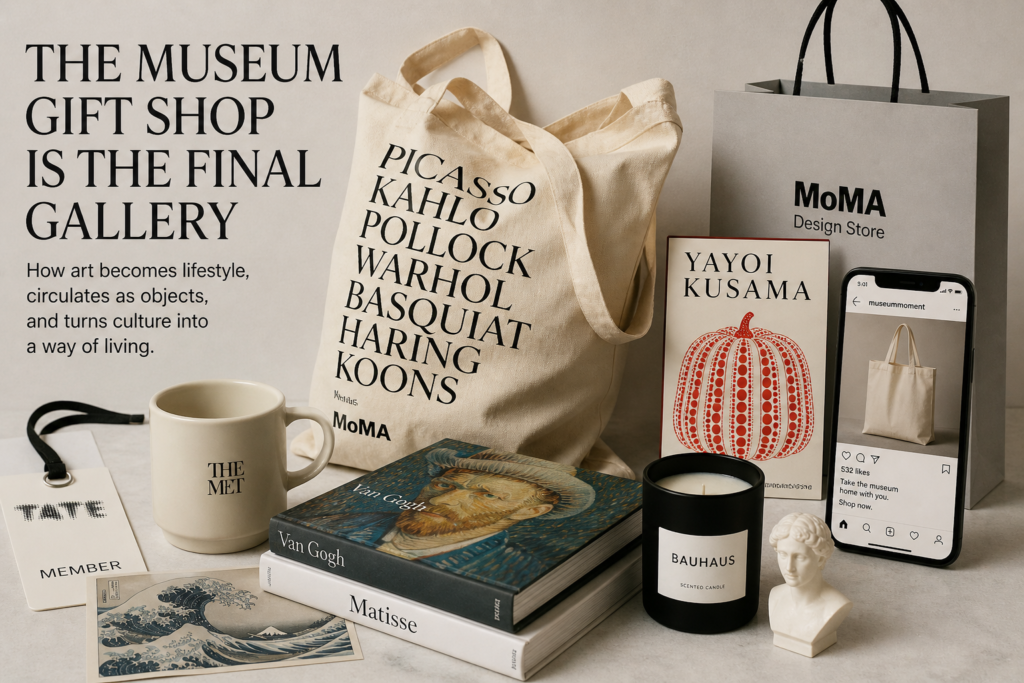
A visitor passes from the gallery into the store carrying the residue of the exhibition: discomfort, admiration, fatigue, confusion, identification, guilt, boredom, inspiration. The shop receives those unstable feelings and offers them form. A book for seriousness. A tote bag for affiliation. A scarf for refinement. A postcard for memory. A mug for domestic absorption. A children’s toy for generational transmission. A limited edition for controlled proximity to exclusivity.
The gallery asks the viewer to confront. The shop asks the viewer to choose.
That choice is seductive because it resolves the difficulty of looking. An artwork may demand that we sit with contradiction. A product allows us to carry away a manageable fragment. It converts experience into evidence: I was there, I saw this, I belong near this, I know what this means. The object becomes a receipt for cultural encounter.
Walter Benjamin’s account of aura is useful here, though the museum shop does not simply destroy aura through reproduction. It redistributes it. The singular presence of the artwork becomes a series of small, purchasable afterlives. Aura is not lost so much as resized, softened, and made useful.
The question is what gets resized with it.
A radical image does not remain radical simply because it is reproduced. Its force depends on context, use, circulation, and reception. Printed on a tote bag, the image may become a declaration, but it may also become a style. Hung on a refrigerator, it may become memory. Framed above a couch, it may become taste. Reposted on Instagram, it may become identity management.
This is the gift shop’s great ideological skill: it can preserve the image while changing the stakes of encountering it.
The museum shop makes culture touchable. That is its democratic promise. But it also makes culture ownable. That is its danger.
The distinction matters because ownership can feel like understanding. Buying the catalogue can become a substitute for reading the wall text. Wearing the artist tote can become a substitute for thinking through the work. Displaying the postcard can become a substitute for returning to the question the artwork raised. The object gives the viewer a way to stay close to art without remaining answerable to it.
This is especially visible when political art becomes merchandise. Art that emerges from mourning, displacement, racial violence, feminist anger, queer refusal, ecological collapse, or anticolonial struggle may be processed into a visual vocabulary of concern. The shop rarely says this explicitly. It does not need to. Its products perform the smoothing for it.
The difficult becomes beautiful. The beautiful becomes tasteful. The tasteful becomes harmless.
This does not mean every reproduction is betrayal. A catalogue can deepen the encounter. A print can keep a work present in someone’s daily life. A well-designed object can extend the logic of an exhibition rather than flatten it. Museum shops can support artists, designers, publishers, and educators. They can make images available to people who will never own art in any other form.
The problem is not reproduction itself. It is the conversion of difficulty into decorative belonging.
MoMA’s store has long made this conversion central to its public identity. The museum’s 1989 press materials for the MoMA Design Store described a retail space devoted to furniture and design objects, tied to the museum’s broader effort to introduce the public to “good design.” Today, MoMA’s store offers a collection- and exhibition-specific assortment, publications, art-related products, design objects, and MoMA-branded items; one store page describes the museum store as “an extension of each Museum visitor’s journey.”
That phrase, “extension of the visitor’s journey,” is more revealing than it may intend. It suggests that the visitor’s experience does not end with viewing. It continues through shopping. The museum’s authority travels into domestic life through objects that have been selected, approved, and staged under its cultural name.
The gift shop becomes curatorial aftercare.
But aftercare for whom? For the viewer disturbed by the exhibition? For the institution balancing public mission and revenue? For the artwork whose image needs continued circulation? For the brand identity of the museum itself?
A museum store is not a neutral container. It teaches visitors what kind of relationship to have with art after the gallery. Sometimes that relationship is study. Sometimes it is memory. Sometimes it is support. Sometimes it is lifestyle acquisition.
This is where cultural capital becomes small, portable, and affordable enough to circulate widely. The museum shop allows the aura of the institution to be purchased in fragments. You may not collect art, but you can collect signs of proximity to art. You may not have deep knowledge of the exhibition, but you can leave with an object that signals the right kind of attention.
Pierre Bourdieu’s account of taste as socially trained distinction remains useful because the gift shop is one of the places where distinction becomes retail. The visitor does not merely buy an object. The visitor buys a relationship to cultural authority, scaled to budget. A catalogue, tote, print, or design object can function as a modest certificate of cultivated presence.
This is why museum shops are so good at making class feel like appreciation.
The products are not always expensive, but they often carry the museum’s power to legitimate taste. A mug from a museum shop is not just a mug. A tote is not just a tote. A postcard is not just paper. These objects bring institutional proximity into everyday life. They make the owner appear touched by culture even outside the museum’s walls.
The online shop intensifies this dynamic. Once museum retail leaves the building, the gift shop no longer waits at the architectural exit. It follows the viewer home, enters search engines, appears in newsletters, circulates on Instagram, and competes with lifestyle brands. Tate’s online shop sells “art inspired gifts, books and prints,” while MoMA Design Store presents modern and contemporary home décor, technology, furniture, jewelry, and design products as part of a museum-supported retail universe.
The museum’s commercial identity can now reach people who never saw the exhibition, never entered the gallery, and never confronted the work in its institutional context. A museum-branded object can circulate as design culture with only a faint connection to art.
This is not necessarily bad. It may expand access. It may support the museum. It may introduce people to artists, books, and design histories. It may create entry points that are less intimidating than the gallery itself. But it also means that the museum’s retail world can become more legible than its curatorial world.
A person can learn to recognize the museum as a taste system before they encounter it as a space of thought.
That shift matters. The museum is no longer only a place where art is interpreted. It becomes a lifestyle authority. It tells us what to read, wear, gift, display, drink from, write in, place on a desk, and give to a child. The museum object becomes part of an educated domestic self.
Museum shops understand this intuitively. Their best products do not feel like souvenirs. They feel like evidence of a life organized around culture. This is why recent research on museum cultural and creative products emphasizes that such products are “beyond souvenirs,” tied to modes of purchase, daily life, and the desire to carry museum experience beyond the visit.
“Beyond souvenirs” sounds generous. It can be. It can mean deeper connection. But it can also mean a more complete absorption of art into consumption. If the souvenir once said, “I was there,” the lifestyle object says, “This is who I am.”
This is the transformation the museum shop performs so smoothly: art becomes identity without necessarily remaining argument.
The political consequences are subtle but real. When difficult art becomes a lifestyle object, the viewer can possess the sign of seriousness without undergoing the discomfort of serious thought. An artwork about violence can become a beautifully reproduced image. A work about dispossession can become a home accessory. A feminist object can become a giftable motif. A critique of capitalism can become a limited-edition product within a nonprofit retail strategy.
The institution does not have to censor the work. It only has to soften the mode of relation.
This is why the museum gift shop should be understood as an ideological buffer. It sits between the disturbance of art and the habits of consumption. It helps the viewer transition back into the world not by preserving the difficulty of the encounter, but by offering a manageable object through which that encounter can be domesticated.
The buffer is not always malicious. Often it is ordinary, even necessary. Museums are underfunded. Visitors want mementos. Artists need income. Designers need platforms. Publications need buyers. Children need entry points. Public institutions need multiple forms of support.
But the ordinariness of the gift shop is exactly why it deserves criticism. Ideology often works best when it looks like convenience.
A museum shop asks a question the institution may not want to answer: what does the museum believe art is for once it becomes sellable?
If the answer is only revenue, the shop becomes a branding machine. If the answer is only access, the shop risks confusing possession with understanding. If the answer is education, then the shop must be curated with the same seriousness as the galleries. It must think about context, authorship, compensation, political meaning, and the ethics of translation.
What would a less neutralizing museum shop look like? It would not simply refuse merchandise. Refusal would be easy and probably false. Instead, it would make the translation visible. It would explain why a particular object exists, who made it, who benefits from it, how it relates to the work, and what cannot be carried home. It would resist turning every difficult image into a tasteful pattern. It would allow products to remain strange, uncomfortable, specific, or demanding.
It would understand that access is not the same as smoothness.
The most serious museum shops already do some of this. They publish books that deepen interpretation. They support artist-designed editions that complicate rather than decorate. They sell objects whose material logic extends an exhibition instead of merely illustrating it. They commission designers and makers with transparency. They allow the shop to be a site of thought, not just extraction from thought.
But too often, the museum shop behaves like a cultural laundering room. Art enters carrying conflict and leaves as taste.
The visitor may still be changed by the exhibition. A postcard does not erase an encounter. A tote does not cancel political commitment. A mug does not make a radical work harmless by itself. Objects are not that simple. People are not that simple.
Still, the system has a direction. It moves from confrontation toward possession, from argument toward affiliation, from public difficulty toward private décor. It allows the museum to extend its reach while reducing the risk of what it extends.
This is why the museum gift shop is not a secondary space. It is one of the clearest places to see how contemporary art institutions manage contradiction. Public mission and private consumption meet there. Radical history and tasteful design meet there. Institutional authority and personal identity meet there. The museum’s critique of capitalism and its participation in commerce meet there, often on the same shelf.
We should stop pretending that shelf is innocent.
The museum gift shop is where art goes after it has asked too much of us. Sometimes it helps us remember. Sometimes it helps us study. Sometimes it helps artists and institutions survive. But sometimes it gives us a way to admire difficulty without being changed by it.
That is the danger of tasteful access. It can bring art closer while making its demands smaller.